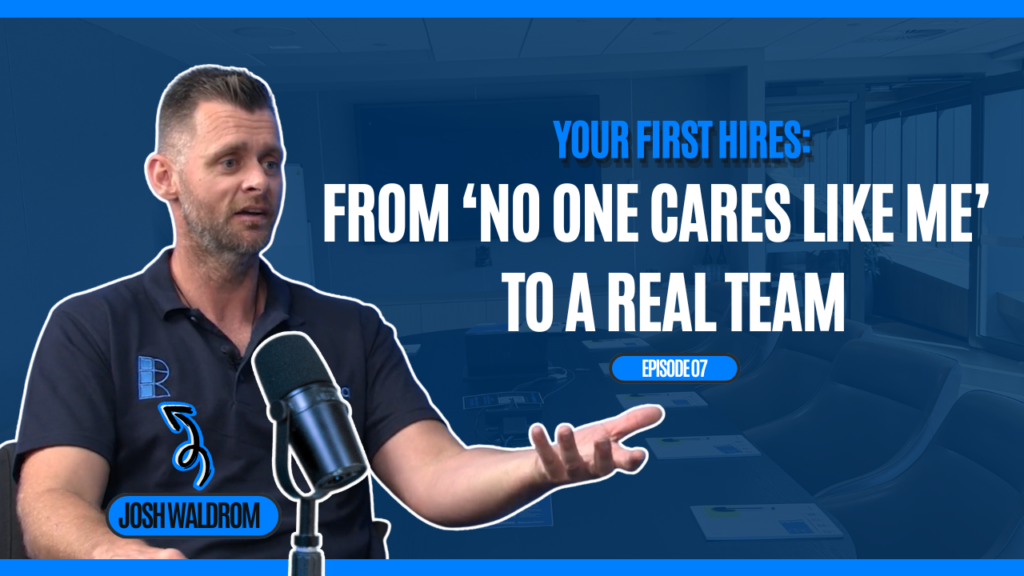
Your First Hires: From ‘No One Cares Like Me’ to A Real Team
Hiring for trade business growth is where many trade business owners hit their first real leadership challenge.
As trade business owners grow, they often reach the same moment.
Work is coming in, and as a result, jobs are stacking up while demand remains strong.
However, instead of things getting easier, everything starts to feel heavier.
At this stage, you’re still involved in everything. In addition, the team needs constant direction, and mistakes happen when you step away.
Eventually, the thought creeps in:
“No one cares like I do.”
This is where many trade business owners struggle with hiring for trade business growth and start to feel stuck.
In this podcast episode, we unpack the shift required to move from doing everything yourself to building a real team — one that performs, delivers, and supports growth.
Importantly, hiring people doesn’t automatically create a team.
Instead, structure does. Leadership does. Systems do.
If you’d like to explore this topic in more detail, listen to the full podcast episode where we discuss why you’re busy but broke. Meanwhile, you can listen to more episodes here.. Listen to more episodes here
Why Hiring Feels So Frustrating at First
Bringing on your first hires should make life easier.
Instead, for many trade business owners, it creates more pressure.
You spend time training. You answer questions all day. You fix mistakes. Productivity doesn’t improve the way you expected.
That’s when frustration builds.
It starts to feel like hiring has made things harder, not better.
The issue isn’t the people.
The issue is that most businesses hire before building the structure required to support a team.
Want to get more out of your current team—without hiring more people?
Check out our blog on Double Team the Resvita Way and learn how to increase performance, accountability, and consistency using the team you already have.
Because building a real team isn’t about more people—it’s about better systems, stronger leadership, and clear structure.
Without structure, hiring for trade business growth often leads to confusion instead of clarity.
The Real Problem: No System for People to Succeed
Many trade businesses grow from individual effort.
In the early days, everything runs through the owner. Decisions are made quickly. Standards live in your head. Processes are flexible.
That works when it’s just you.
It doesn’t work when you start hiring.
Without systems, new team members are left guessing:
- How should this job be done?
- What standard is expected?
- Who is responsible for what?
When answers aren’t clear, performance becomes inconsistent.
This is where many trade business owners fall into the trap of thinking:
“It’s easier if I just do it myself.”
That mindset keeps the business stuck.
The Shift: From Doing the Work to Leading the Team
One of the biggest mindset shifts discussed in the episode is this:
Your role must change if you want your business to grow.
Instead of being the best person on the tools, you need to become the person who builds a business that performs.
This means moving from:
- Doing → Leading
- Reacting → Planning
- Fixing problems → Preventing them
- Individual output → Team performance
This is how you start building a scalable asset, not just a busy job.
Visit our website for practical tools, frameworks, and support to help you implement systems that actually work in your trade business.
What Builds a Real Team (Not Just Employees)
Hiring alone doesn’t create leverage.
Structure does.
Here are three key elements that turn your first hires into a real team.
1. Clear Systems and Processes
Your team can only perform as well as the system they operate in.
Every job should follow a consistent process. Expectations should be clear. Steps should be repeatable.
Without this, every job becomes guesswork.
2. Defined Roles and Accountability
When roles aren’t clear, work overlaps or gets missed.
Each team member needs to understand:
- What they are responsible for
- What success looks like
- How their role contributes to the bigger picture
Clarity reduces confusion and improves performance.
3. Leadership and Standards
Leadership isn’t about doing everything.
It’s about setting the standard and holding it.
Trade business owners need to communicate expectations, provide direction, and guide the team toward consistent results.
Without leadership, even good people struggle to perform.
The Benefits of Building a Real Team
Once trade business owners shift from hiring individuals to building a structured team, the impact is significant.
More Work Completed Without Chaos
Jobs move through the business with less friction.
Reduced Reliance on the Owner
The business no longer depends on you for every decision.
Improved Quality and Consistency
Systems create repeatable results.
Scalable Growth
The business can grow without increasing stress at the same rate.
Instead of carrying the workload alone, the team becomes an asset that drives performance.
Signs You’re Stuck in the “No One Cares Like Me” Stage
Many trade business owners recognise this phase once they step back.
Common signs include:
- You’re involved in every decision
- The team constantly asks for direction
- Mistakes happen when you’re not present
- Productivity drops when you step away
- You feel like no one meets your standards
These signals don’t mean your team is the problem.
They usually mean the system needs to improve.
What Trade Business Owners Can Do Next
Building a strong team doesn’t happen overnight.
It starts with simple, structured changes.
Document how jobs should be done
Take what’s in your head and turn it into a process.
Define roles clearly
Make sure each person knows their responsibilities.
Set clear standards
Explain what good work looks like.
Step into leadership
Focus more on guiding the team and less on doing every task.
These steps create the foundation for a team that performs consistently.
Join our live events to see how this all comes together in real time—practical strategies, real conversations, and direct guidance to help you build a structured, scalable business.
Final Thoughts
Every trade business owner wants a reliable team.
However, getting there requires more than just hiring people.
It requires a shift in how the business operates.
The goal isn’t to find people who care as much as you do.
The goal is to build a business where people can perform at a high level because the structure supports them.
That’s how you move past the growth ceiling.
That’s how you build a scalable trade business.
If this topic resonated, the full podcast episode dives deeper into how trade business owners can hire effectively, build stronger teams, and create a business that doesn’t rely on them for everything.
Because real growth doesn’t come from doing more yourself.
It comes from building a team that can deliver without you.
Real progress with hiring for trade business growth comes from systems, leadership, and consistency—not just adding people.
Q&A
Q: Why does hiring feel harder before it gets easier?
A: Because without systems in place, new hires rely on you for everything. This creates more questions, more mistakes, and more pressure instead of relief.
Q: What’s the biggest mistake trade business owners make when hiring?
A: Hiring people before building the structure they need to succeed—clear processes, defined roles, and expectations.
Q: What does “no one cares like I do” really mean?
A: It usually signals a lack of systems, not a lack of good people. When expectations aren’t clear, performance will always fall short.
Q: How do you move from doing everything to leading a team?
A: Shift your focus from completing tasks to creating systems, setting standards, and guiding your team’s performance.
Q: What are the key elements of a strong team?
A: Clear processes, defined roles, and consistent leadership. These create structure and accountability.
Q: How do systems improve team performance?
A: They remove guesswork, create consistency, and allow your team to complete jobs to a clear standard without constant direction.
Q: What are signs your business is stuck at a growth ceiling?
A: You’re involved in every decision, your team depends on you constantly, and things fall apart when you step away.
Q: What’s the first step to building a real team?
A: Document how work should be done so your team has a clear, repeatable process to follow.
Q: Do you need perfect systems before hiring?
A: No—but you do need basic structure. Start simple, then improve as your team grows.
Q: What’s the long-term benefit of building a structured team?
A: A business that runs more smoothly, delivers consistent results, and grows without relying on you for everything.