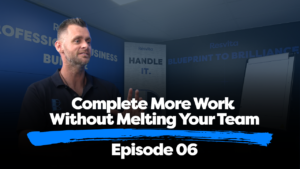
Complete More Work Without Melting Your Team
At some point, every trade business owner hits the same wall.
Work is coming in. Demand is strong. Opportunities are there.
But instead of growth feeling exciting, it starts to feel heavy.
The team is stretched. Mistakes creep in. Pressure builds.
This isn’t just being busy.
If you’d like to explore this topic in more detail, listen to the full podcast episode where we discuss Why you’re busy but broke. Listen to more episodes here
You’ve hit a growth ceiling.
In this podcast episode, we break down a critical shift for trade business owners who want to scale:
How to complete more work without burning out your team.
Because growth shouldn’t come at the cost of your people, your quality, or your profit.
Why More Work Starts Creating Problems
When a trade business is small, pushing harder can solve most issues.
More effort means more output.
As the business grows, that approach stops working.
More jobs don’t just mean more revenue — they mean more complexity:
- More coordination
- More communication
- More moving parts
- More pressure on the team
Without the right systems, growth creates cracks.
Deadlines slip. Rework increases. Team morale drops.
What once felt like progress starts to feel like chaos under pressure.
Explore how we can support your growth: CLICK HERE
The Real Problem: No Structure for Growth
The issue isn’t your team.
It’s not a lack of effort either.
Most trade business owners are working hard, and their teams are doing their best.
The real problem is a lack of structure, performance systems, and leadership frameworks.
Many businesses are still operating with systems designed for survival — not for scale.
That’s where the shift needs to happen.
To complete more work without burning out your team, the business must evolve from:
- Reactive workflows → Structured systems
- Individual effort → Team performance
- Constant firefighting → Planned execution
This is how you move from pressure to control.
Join the Resvita community and start building capacity the right way – JOIN HERE
The Shift: From Output to Capacity
One of the key insights from the episode is this:
Scaling isn’t about doing more. It’s about increasing capacity.
Capacity is the ability of your business to deliver work consistently without breaking the team or the system.
Without capacity, growth creates stress.
With capacity, growth creates leverage.
This shift changes everything.
Instead of asking, “How do we get more done?”
You start asking:
“How do we build a business that can handle more — without strain?”
What Allows You to Complete More Work (Without Burning Out Your Team)
A scalable trade business doesn’t rely on pushing harder.
It relies on structure.
Here are three key elements that make this possible.
1. Clear Systems and Processes
Every job should follow a consistent workflow.
When processes are documented and repeatable, the team doesn’t need to reinvent the wheel every time.
This reduces errors and increases efficiency.
2. Defined Roles and Responsibilities
Confusion creates pressure.
When team members are unclear on what they own, work overlaps or gets missed entirely.
Clear roles improve accountability and reduce bottlenecks.
3. Strong Leadership and Communication
As the business grows, leadership becomes more important than technical skill.
Trade business owners need to guide direction, set expectations, and support the team.
Good communication ensures everyone stays aligned.
Check out upcoming events and training opportunities
The Benefits of Building Capacity in Your Business
When trade business owners focus on structure instead of just output, the results are significant.
More Work Completed Without Chaos
Jobs flow more smoothly through the business.
Stronger Team Performance
The team operates with clarity and confidence.
Improved Profit Margins
Efficiency reduces waste and rework.
Scalable Growth
The business can handle more work without breaking systems or people.
Instead of pushing harder, the business becomes more capable.
Signs Your Team Is Being Pushed Too Hard
Many trade business owners don’t realise the strain on their team until problems start appearing.
Look out for these warning signs:
- Frequent mistakes or rework
- Missed deadlines
- Constant stress or frustration on site
- High reliance on you for decisions
- Team members feeling overwhelmed
These signals usually indicate that the business has outgrown its current systems.
What Trade Business Owners Can Do Next
Improving capacity doesn’t require massive changes overnight.
Start with small, structured steps.
Map out your workflow
Understand how jobs move through your business.
Identify bottlenecks
Find where delays and pressure occur.
Simplify your systems
Focus on consistency rather than complexity.
Invest in leadership
Spend more time guiding the business instead of just working in it.
These steps begin the shift from survival to scalable growth.
If you want to learn more about communication read here
Final Thoughts
Many trade business owners believe growth means doing more work.
In reality, growth requires building a business that can handle more work.
That’s a big difference.
The goal isn’t to push your team harder.
It’s to build a scalable asset that delivers consistent results without burning people out.
When the right systems, structure, and leadership are in place, completing more work becomes easier — not harder.
If this topic resonates, the full podcast episode dives deeper into how trade business owners can increase capacity, strengthen their team, and scale sustainably.
Because real growth isn’t measured by how hard your team works.
It’s measured by how well your business performs under pressure.
Q&A: Completing More Work Without Burning Out Your Team
Question: What does it actually mean to “complete more work without burning out your team”?
Short answer: It means increasing your business capacity—not just pushing your team harder. You’re able to deliver more jobs efficiently because your systems, structure, and leadership support the workload, rather than relying on extra effort.
If you want a deeper breakdown of this shift, we cover it step by step in the full podcast episode.
Question: Why does my team struggle when we take on more work?
Short answer: Because more work adds complexity, not just volume. Without clear systems and structure, the extra workload creates confusion, delays, and pressure—leading to mistakes and burnout.
We dive deeper into how to manage this in the podcast, including how to stabilise operations as demand increases.
Question: Isn’t pushing harder part of growing a trade business?
Short answer: Only in the early stages. At a certain point, pushing harder stops working and starts creating problems. Growth requires better systems, clearer roles, and stronger leadership—not just more effort.
If you’re still relying on effort alone, this guide will help you shift toward structure:
https://www.resvita.com.au/simple-job-management-for-tradies-how-to-get-off-the-tools-a-bit/
Question: What are the signs my team is getting burned out?
Short answer: Common signs include frequent mistakes, missed deadlines, constant stress on-site, and heavy reliance on you for decisions. These usually indicate your business has outgrown its current systems.
We explain how to identify and fix these pressure points in the podcast episode.
Question: What’s the difference between doing more work and increasing capacity?
Short answer: Doing more work is about output—pushing your team to get through more jobs. Increasing capacity is about building a business that can handle more work consistently, without strain.
This distinction is key to sustainable growth, and it’s a major focus of the podcast discussion.
Question: What systems help trade businesses scale without burnout?
Short answer: The essentials are:
- Clear, repeatable workflows
- Defined roles and responsibilities
- Strong communication and leadership
These systems reduce confusion, improve efficiency, and allow your team to perform at a higher level without added stress.
This is exactly what we help trade business owners implement through our programs and events.
Question: How do I start improving capacity in my business?
Short answer: Start by mapping your current workflow, identifying bottlenecks, and simplifying how work moves through your business. Focus on consistency first—then build from there.
If you’re unsure where to begin, the podcast walks through practical first steps you can apply immediately.
Question: Can I scale my trade business without hiring more people?
Short answer: In many cases, yes—at least initially. Most businesses have untapped capacity due to inefficiencies. By improving systems and structure, you can often complete more work with your existing team before needing to hire.
We explore this in more detail in the episode, including when hiring actually makes sense.
Question: Where can I learn more or get help implementing this?
Short answer: Start with the full podcast episode where we break this down in detail.
If you’re ready to take action, explore our resources designed specifically for trade business owners:
👉 Listen to the podcast: https://www.resvita.com.au/podcast/
👉 Explore programs, events, and support: https://www.resvita.com.au/