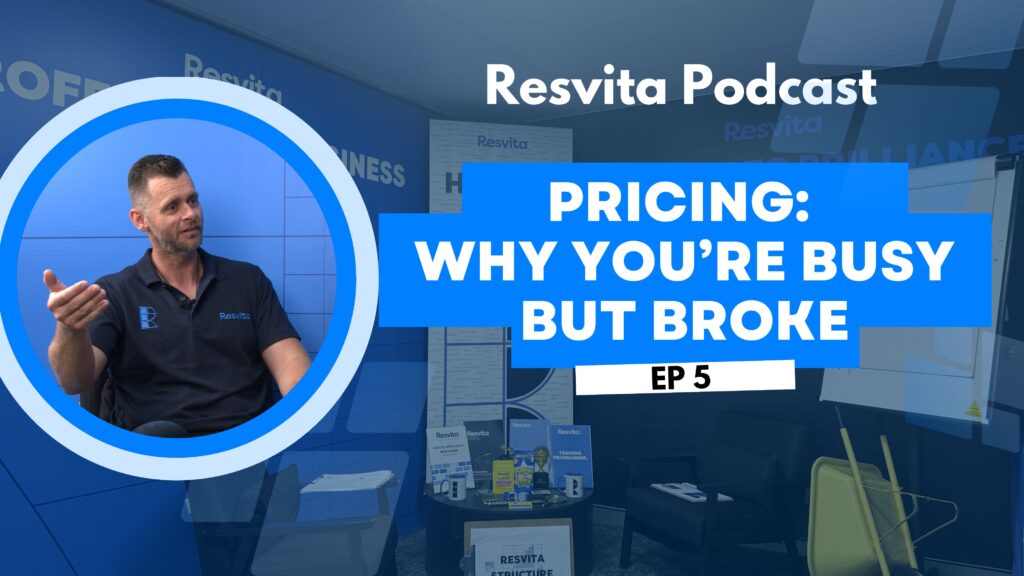
Pricing: Why You’re Busy But Broke
You’re flat out.
Jobs are booked. The phone keeps ringing. The team is working. From the outside, it looks like the business is doing well.
But behind the scenes, something doesn’t add up.
Cashflow is tight. Profit feels inconsistent. Growth feels harder than it should.
This is where many trade business owners hit a wall — not because they lack work, but because they’ve hit a growth ceiling.
In this podcast episode, we unpack one of the biggest issues holding trade businesses back:
Pricing.
Many trade business owners are busy, yet still broke. The right pricing strategy can change that.
If you’d like to explore this topic in more detail, listen to the full podcast episode where we discuss Why you’re busy but broke. Listen to more episodes here
The Real Problem: Busy Doesn’t Mean Profitable
Most trade business owners measure success by how busy they are.
More jobs should mean more money, right?
Not always.
Without the right pricing, more work can raise pressure without boosting profit. Every job adds complexity, time, and cost — but if margins aren’t right, the business doesn’t move forward.
Instead of building a scalable asset, many trade business owners end up stuck in a cycle of:
- High workload
- Low margins
- Constant cashflow pressure
This isn’t a work problem.
It’s a pricing problem.
Why Most Trade Business Owners Get Pricing Wrong
Pricing in construction isn’t just about covering costs.
It’s about building a business that can perform, grow, and generate real profit.
However, many trade business owners fall into common traps.
1. Pricing to Win the Job
Winning the job often becomes the priority.
Quotes are adjusted to stay competitive. Margins are squeezed just to secure work.
Over time, this creates a business that’s busy but underpaid.
2. No Clear Cost Structure
Without clear financial systems, pricing becomes guesswork.
Labour, materials, overheads, and hidden costs aren’t always calculated properly. As a result, jobs look profitable upfront but fall short once completed.
3. No Margin for Growth
Many trade business owners price jobs just to survive.
There’s little allowance for reinvestment, team development, or business growth. Without margin, there’s no leverage — and without leverage, scaling becomes difficult.
Want to go deeper into improving your trade business?
Check out these related articles:
- Simple Job Management for Tradies: How to Get Off the Tools (A Bit)
- Is Your Business Structure Costing You Money? A Guide for Tradies
These break down practical strategies to help you get off the tools and structure your business for better profitability.
The Shift: From Survival Pricing to Performance Pricing
One of the key insights from the episode is the need to shift from survival mode to performance-based pricing.
This is where the real change happens.
Instead of asking, “What do I need to charge to win this job?” The better question becomes:
“What do I need to charge to build a profitable, scalable business?”
This shift moves the focus from short-term work to long-term outcomes.
It introduces structure, clarity, and control into the pricing process.
What a Strong Trade Business Pricing Strategy Looks Like
A proper trade business pricing strategy isn’t complicated, but it does require structure.
It focuses on three key areas.
1. Understanding Your True Costs
Every job needs to account for:
- Labour (including your time)
- Materials
- Overheads
- Business expenses
Without this clarity, pricing will always be inconsistent.
2. Building in Profit Margins
Profit isn’t what’s left over.
It should be built into every job from the start.
A structured pricing model ensures each project contributes to business growth, not just cashflow.
3. Pricing for Capacity and Growth
Pricing should reflect where the business is heading — not just where it is now.
As demand increases, pricing should evolve to support:
- Team expansion
- Improved systems
- Better project delivery
- Long-term scalability
This is how a trade business moves from constant work to controlled growth.
Ready to stop working harder for less?
Start building a trade business that actually delivers consistent profit, strong cashflow, and real growth.
The Benefits of Fixing Your Pricing
Once trade business owners implement a structured pricing approach, the results are noticeable.
Stronger Profit Margins Each job contributes to the bottom line.
Improved Cashflow More predictable income reduces financial stress.
Better Job Selection You can choose the right projects instead of taking everything.
Scalable Growth Pricing supports expansion rather than limiting it.
Instead of working harder for the same result, the business starts working smarter.
Signs Your Pricing Is Holding You Back
Many trade business owners recognise the problem once they step back and review their numbers.
Your pricing may need attention if:
- You’re busy but not seeing consistent profit
- Cashflow feels tight despite steady work
- Jobs often cost more than expected
- You’re competing heavily on price
- Growth feels difficult even with strong demand
These are clear indicators that your trade business pricing strategy needs to evolve.
What Trade Business Owners Can Do Next
Fixing pricing doesn’t require a complete overhaul overnight.
Start with a few simple steps.
Review your past jobs Identify where profit was lost or underestimated.
Understand your true costs Get clarity on what it actually takes to run your business.
Set target margins Decide what profit looks like for your business.
Stop pricing just to win work Focus on building a sustainable and scalable business.
These changes create a stronger financial foundation.
Final Thoughts
Many trade business owners believe the solution to growth is more work.
In reality, more work without the right pricing often creates more pressure.
The goal isn’t just to stay busy.
It’s to build a profitable, scalable trade business that creates real financial results.
A strong trade business pricing strategy is one of the most powerful tools to make that happen.
If this topic caught your interest, check out the full podcast episode. It explores how trade business owners can fix pricing, boost margins, and create a successful business.
Because being busy isn’t the goal.
Building a business that performs, scales, and creates profit is.
Q&A
Question: What do you mean by “busy but still broke”?
Short answer: It means your schedule is full, but your numbers don’t reflect it. You’re completing jobs, the team is working, and revenue is coming in—but after costs, there’s little left. This usually comes down to pricing. Without the right margins, more work doesn’t create more profit—it just creates more pressure.
If this sounds familiar, we break this down further in the full podcast episode, including why it happens and how to fix it.
Question: Isn’t being busy a good sign my business is doing well?
Short answer: Not always. Being busy only shows there’s demand—it doesn’t guarantee profitability. If your pricing isn’t structured properly, every extra job can stretch your resources without improving your bottom line.
We’ve also covered how to balance workload and control in this guide:
https://www.resvita.com.au/simple-job-management-for-tradies-how-to-get-off-the-tools-a-bit/
Question: Why do so many trade business owners struggle with pricing?
Short answer: Because pricing often becomes reactive instead of strategic. Many tradies price to win jobs, not to build a business. Without clear cost tracking, defined margins, and a structured approach, pricing turns into guesswork—leading to inconsistent profit and ongoing cashflow stress.
In the podcast, we unpack the most common pricing mistakes and what to do instead.
Question: What’s the difference between survival pricing and performance pricing?
Short answer: Survival pricing focuses on getting the job and covering immediate costs. Performance pricing focuses on building a business that generates profit, supports growth, and creates long-term stability.
If you’re thinking about long-term structure, this article also ties in closely:
https://www.resvita.com.au/blog-is-your-business-structure-costing-you-money-a-guide-for-tradies/
Question: What should be included in a proper pricing strategy?
Short answer: A strong pricing strategy covers your true costs (labour, materials, overheads), includes clear profit margins, and aligns with your business capacity and growth plans. It’s structured, consistent, and built for scalability.
This is exactly what we help trade business owners implement through our programs and events.
Question: How do I know if my pricing is holding my business back?
Short answer: Common signs include being consistently busy with little profit, tight cashflow, jobs going over budget, and competing heavily on price. If growth feels difficult despite strong demand, pricing is often the issue.
If you’re noticing these signs, it’s worth diving deeper into the podcast to understand what’s really happening behind the numbers.
Question: What’s the first step to fixing my pricing?
Short answer: Start by understanding your numbers. Review past jobs, identify where profit was lost, and calculate your true costs. From there, set clear target margins and begin pricing with intention—not just to win work, but to build a profitable business.
From there, many business owners choose to get structured support to implement this properly and avoid costly trial and error.
Question: Where can I learn more or get help implementing this?
Short answer: Start with the full podcast episode where we break this down step by step.
If you’re ready to take it further, explore our programs, events, and resources designed to help trade business owners build profitable, scalable businesses with the right systems in place.
👉 Listen to the podcast: https://www.resvita.com.au/podcast/
👉 Explore programs & events: https://www.resvita.com.au/